|
|
“What is the connection between the life I’m
living and the objects I’m forming?” asks the potter Paulus
Berensohn. This is a question I try to come to terms with in my
work. In my everyday life I attempt to live simply, literally
surrounded by nature, which is a deep source of inspiration for
me. I am dedicated to promoting awareness, reverence, and
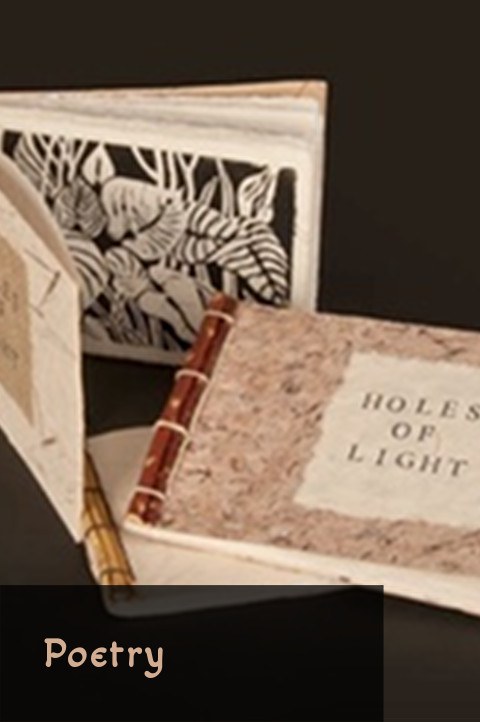
ultimately, preservation of the natural world. The haiku poetry
that I write informs my visual art, and visa versa. These are some
of the values I want reflected in “the objects I’m forming.”
One way I do this is to use natural
materials in my work. Stones, pods, bark, grasses, roots, twigs
and vines are some of the organic components of my pieces.
Because sustainable harvesting is important to me, I am careful to
leave more than I take from wild plant communities. The fact that
my supplies are abundant, renewable, non-toxic and biodegradable
supports my ecological values.
While out in the woods, fields and hills
gathering raw materials, I also gather visual images for my
designs. I love the contrasting textures, subtle colors, gestural
lines and organic shapes intrinsic to the natural world. Back in
the studio, combinations of these foraged objects and images
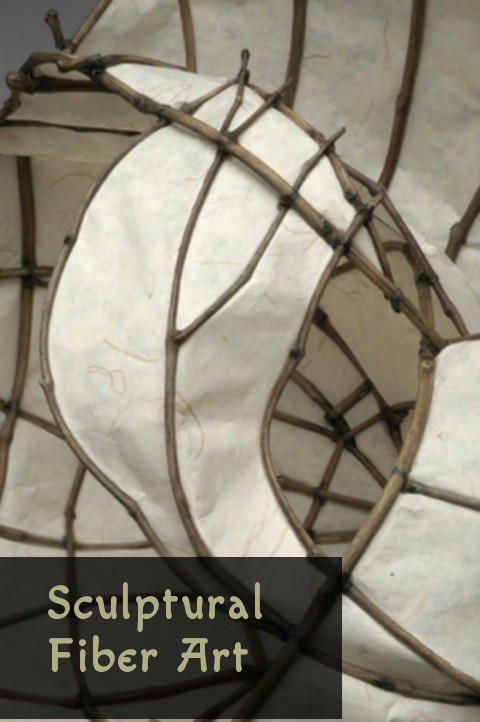
become transformed into new configurations. The sculptures begin
with armatures constructed from linear elements, such as vines and
branches, with handmade paper integrated into these
three-dimensional “drawings.” In other pieces the underlying
forms are built up with layers of cast handmade paper. Found
natural objects are incorporated into the compositions of these
small environments. It is important to me to preserve the essence
of the materials throughout the changes they must undergo in the
art making process. Even when they are radically altered in form,
such as when plants are made into paper, I want something of their
identity and origin to remain.
My present work is a fusion of a background
in fine arts with years spent honing a basket maker’s craft.
Originally I made traditional functional baskets as a way to
support myself through a cottage industry I started on my small
farm. Over time, the baskets evolved into increasingly abstract
personal statements. These pieces have become containers of
meaning as well as of matter. Natural objects within the work
exist both as themselves and as metaphor, much as do the images in
haiku poetry. A kind of visual haiku results, offering a focus for
contemplation. Simplicity, containment, fertility, openings,
passageways, and the tension between the hidden and the revealed
are some of the themes explored.
In collaborating with nature, I want to give
voice to it as well to my own human sensibilities and perceptions.
I wish to promote balance, rather than domination, appreciation,
rather than exploitation. It is my desire that the people who
view my work will absorb the energies of the natural elements
within it, strengthening their personal connection to nature and
joining in my pleasure of its mystery and grace.
|